


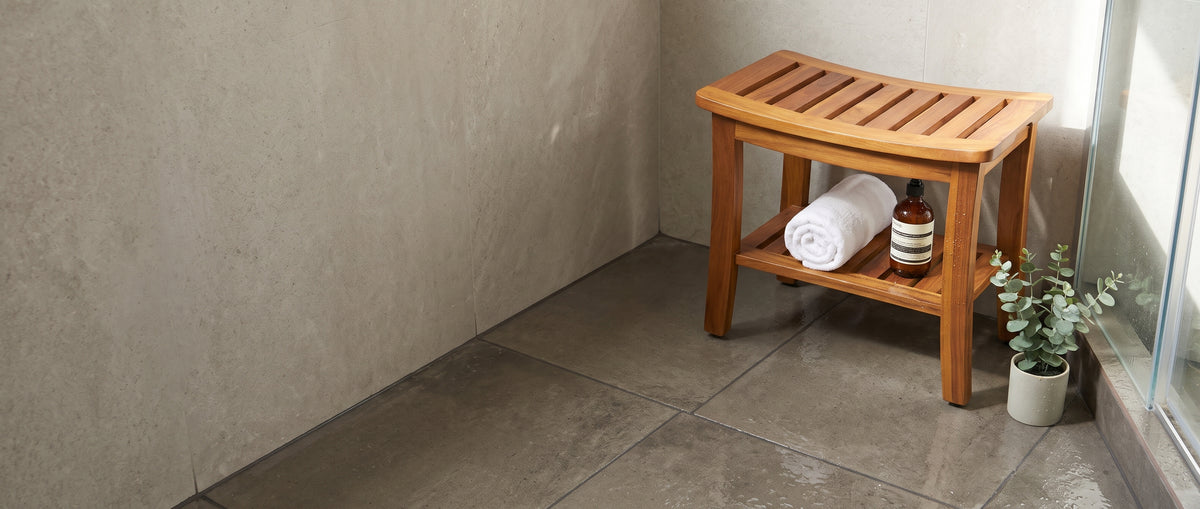
Search for "teak shower bench" and you will find hundreds of options that look almost identical in photos. Prices range from under $100 to several hundred dollars. Some will last for years; others will crack, wobble or turn black within a season. The difference is rarely visible in a thumbnail, so you need to know what to check.
This guide gives you a practical checklist for judging any teak shower bench, whoever makes it. We cover the wood itself, size and height, shape, construction, feet, weight rating, storage shelf, finish, assembly, sourcing and the seller's support. At the end you will find a list of red flags and answers to common questions.
The 12-point checklist
If you only have a minute, use this list. The sections below explain each point.
- Solid teak, ideally stated as 100% solid teak, not "teak finish" or "teak color"
- The right width for your shower, with room left to stand and turn
- A comfortable seat height for the main user
- A shape that suits your space: straight, corner or compact stool
- Slatted seat and shelf with gaps that let water drain
- Solid joinery and corrosion-resistant hardware
- Non-slip feet, ideally adjustable for sloped floors
- A clearly stated weight rating with margin above the heaviest user
- A storage shelf if you want bottles off the floor
- A finish you will be happy with: natural or gray, and no thick varnish
- Fully assembled or simple assembly, depending on your preference
- Clear sourcing, care instructions and a reachable seller
1. Start with the wood: solid teak heartwood
The most important question is what the bench is actually made of.
Why it matters. Teak's reputation for handling water comes from the heartwood of Tectona grandis, which contains natural oils and extractives that resist moisture and decay. Timber authorities rate it in their top durability class for above-ground use. Teak sapwood is much less durable, and other woods stained to look like teak do not share its properties at all.
What to look for.
- Clear language such as "100% solid teak" or "solid Indonesian teak."
- Consistent golden-brown color with natural grain variation. Natural teak is not perfectly uniform.
- A noticeable weight. Teak is dense, at roughly 670 kilograms per cubic meter at 12% moisture content, so a solid bench feels substantial for its size.
- A slightly oily or waxy feel on unfinished natural teak.
Be careful with these phrases: "teak finish," "teak color," "teak stain," "teak oil finish" and "teak-look." They often describe a different wood treated to look like teak. Our guide to solid teak vs teak-finished wood explains how to tell the difference in person and online.
If you are weighing teak against other materials, see teak vs bamboo for wet showers and our teak vs plastic vs aluminum comparison.
2. Choose the right width
A bench that is too wide makes a shower feel cramped and blocks movement. One that is too narrow is uncomfortable and leaves no room for a bottle beside you.
How to measure. Measure the inside width of your shower where the bench will go, and the depth from the wall to where you stand. Leave enough clear floor to stand, turn and step in and out safely.
| Bench width | Usually suits | Notes |
|---|---|---|
| 16 to 18 inches | Small stalls; corner placement; occasional use | Compact stools and corner benches |
| 21 inches | Standard stalls and shower-tub combos | A common all-round size |
| 24 inches | Standard to larger walk-ins | Room to sit and set something down |
| 30 inches | Large walk-ins and wet rooms | Comfortable for longer sits; two-person reach |
Our guide to shower bench size compares 18-, 21-, 24- and 30-inch benches in detail.
3. Check the seat height
Comfort and safety depend on height. Most adults are comfortable when their thighs are roughly level and their feet are flat on the floor. For reference, TeakCraft's 24-inch Elera measures 18.125 inches high; always check the listed height of the model you are considering.
To check, measure from the floor to the back of the knee of the main user while seated, and compare that with the bench height. If several people of very different heights will use the bench, choose for the person who will use it most, or for whoever needs the most support.
If the bench is for an older adult or someone with balance concerns, height is critical. See our guide to shower benches for the elderly for seat height, grip and safety tips, and follow any advice from a clinician.
4. Pick a shape for your shower
Shape determines how a bench fits and how you use it.
- Straight bench. The most versatile. Works against a back wall, at the end of a walk-in or outside the shower. Browse the teak shower bench collection.
- Corner bench. A triangular or quarter-round seat that tucks into a corner and keeps the floor clear in small showers. See the corner shower bench collection.
- Compact stool. A smaller seat for tight stalls or as a footrest. See teak shower stools.
- Curved seat. Some benches, such as the 30-inch Freya, have a gently curved top that some people find more comfortable.
Still deciding? Our corner vs straight shower bench guide compares the two.
5. Look for slats and drainage
A shower bench should shed water, not hold it.
- Slatted seat. Gaps between boards let water run through and air circulate, so the bench dries faster between showers.
- Slatted shelf. A solid shelf collects water and soap. A slatted one drains.
- Rounded edges. Eased edges are more comfortable and shed water more easily.
- No flat traps. Look underneath for spots where water could pool, such as solid rails or recessed joints.
6. Examine construction and hardware
The joints and fasteners decide whether a bench stays solid for years or starts to wobble.
- Joinery. Well-fitted joints, such as mortise-and-tenon or tight dowel joints, hold up better through humidity cycles than simple butt joints held only by screws.
- Hardware. Fasteners should resist corrosion. Stainless steel is a good sign; plain steel can rust and stain the wood. TeakCraft's Freya, for example, lists stainless steel hardware.
- Slat thickness. Slats should feel firm under pressure, with no noticeable flex.
- Finish quality. Sanded smooth with no splinters, rough edges or gaps at the joints.
- Stability test. If you can see the bench in person, press down on one corner. It should not rock or creak.
7. Insist on good feet
Feet are easy to overlook and critical for safety on wet tile.
- Non-slip material. Rubber feet grip wet tile far better than bare wood.
- Raised legs. Feet lift the end grain of the legs out of standing water, which helps the wood last.
- Adjustability. Many shower floors slope toward the drain. Adjustable leveling feet let you stop the bench from rocking. The Elera's product page, for example, lists adjustable non-slip leveling feet.
- Replaceability. Ask whether replacement feet are available. Rubber wears over time.
Whatever bench you choose, check that it sits level and steady before each use.
8. Confirm the weight rating
A reputable seller states a clear weight capacity. Choose a bench rated comfortably above the heaviest person who will use it.
For reference, most TeakCraft shower benches list a 350-pound capacity, and the heavy-duty Elera and Danica list 400 pounds. If a listing gives no weight rating at all, treat that as a reason to ask questions or look elsewhere.
Remember that a weight rating describes sitting, not standing or rocking. Do not stand on a shower bench.
9. Decide whether you want a storage shelf
A lower shelf turns a bench into storage. It keeps bottles, a loofah or a folded towel off the floor and within reach.
Pros: reduces clutter, adds storage without drilling, steadies the frame with an extra rail.
Cons: a shelf can make it slightly harder to clean underneath, and bottles left on it can leave mineral rings in hard-water areas.
TeakCraft benches with a shelf include the Freya 30-inch, the Elera and the Danica. Corner benches such as the Ra 17.5-inch corner bench add a basket underneath.
10. Choose a finish you will live with
Natural teak has a warm, honey-gold tone. Over time, with water and light, it gradually softens toward silver-gray unless it is oiled. You can embrace the patina or maintain the color with a thin coat of teak oil.
Rustic gray teak has a gray finish applied over solid teak. TeakCraft hand-applies its rustic gray finish, so shade and grain vary slightly from piece to piece. Care is the same as natural teak, except that you should not sand it.
Avoid thick film finishes. Varnish, lacquer and polyurethane can crack in a humid shower and trap water underneath. Quality teak benches are left natural, oiled or finished in a way that lets the wood breathe.
11. Fully assembled or flat-pack?
Some benches ship flat and need assembly; others arrive ready to use.
Fully assembled benches are built and tightened by the maker, so joints are set correctly from the start and you avoid the risk of a loose screw or a joint that was not fully seated. Every TeakCraft shower bench arrives fully assembled.
Flat-pack benches can be cheaper to ship and easier to carry into tight spaces. If you choose one, follow the instructions carefully, use the supplied hardware, and re-check the tightness after a few weeks of use.
12. Check sourcing, care instructions and support
Sourcing. Ask where the teak comes from and whether it is legally sourced. Indonesia operates a national timber legality system known as SVLK. Several TeakCraft product pages, including the Freya, Eske and Hermod, describe the teak as SVLK-certified legal teak. A legality certificate is not the same as a guarantee of environmental performance, so read what any certification actually covers.
Care instructions. A good seller tells you exactly how to care for the bench: how to clean it, whether and how often to oil it, and what to avoid. TeakCraft publishes a full teak shower bench care guide.
Support. Look for a seller with a phone number or email you can reach, clear shipping and return policies, and real product dimensions on every listing.
Red flags to watch for
| Red flag | Why it matters |
|---|---|
| "Teak finish," "teak color" or no species named | Probably not solid teak |
| Claims the bench is "waterproof" or "mold-proof" | No wood is either; overclaiming is a warning sign |
| No weight rating | You cannot judge safety |
| No dimensions or height | You cannot judge fit |
| Plain steel screws | Can rust and stain |
| Solid, unslatted seat or shelf | Holds water |
| Thick glossy varnish | Can crack and trap moisture |
| Very light weight for its size | May not be solid teak, or may be thin |
| No care instructions or contact details | Little support after the sale |
Curious why "waterproof" is a red flag? Our guide to whether a waterproof shower bench really exists explains the difference between waterproof and water-resistant.
How TeakCraft benches line up with the checklist
| Checklist point | TeakCraft shower benches |
|---|---|
| Wood | Solid Indonesian teak |
| Widths | 16- to 17.5-inch corner benches; 21, 24 and 30 inches straight |
| Finish | Natural teak or hand-applied rustic gray |
| Drainage | Slatted seats and shelves |
| Weight rating | 350 lb on most models; 400 lb on Elera and Danica |
| Feet | Non-slip rubber feet; adjustable leveling feet on some models |
| Assembly | Fully assembled |
| Use | Indoor and outdoor |
Models and stock change, so check each product page for current details. A few starting points: the compact 21-inch Hermod, the mid-size 24-inch Eske, and the heavy-duty 24-inch Elera.
Match the bench to your shower type
Different showers favor different benches. Use this as a starting point, then check your own measurements.
| Shower type | Recommended shape | Typical width | Features worth having |
|---|---|---|---|
| Small square stall | Corner bench or compact stool | 16 to 18 inches | Basket underneath for bottles |
| Standard stall | Straight bench | 21 inches | Lower shelf; non-slip feet |
| Shower-tub combo | Compact straight bench or stool | 16 to 21 inches | Narrow depth; check tub floor width |
| Walk-in shower | Straight bench at the far end | 24 to 30 inches | Shelf; curved seat for comfort |
| Curbless or wet room | Straight bench or two pieces | 30 inches, or a bench plus corner bench | Adjustable feet for floor slope |
| Outdoor shower | Straight bench | 21 to 30 inches | Indoor-outdoor rating; natural teak that can weather |
Compare listings side by side
When you have narrowed it down to two or three benches, put them in a simple comparison. Note the answer to each of these for every bench you are considering; filling it in often makes the choice obvious.
- Is the material stated as solid teak?
- Width x depth x height (inches)
- Weight rating (lb)
- Slatted seat and shelf?
- Feet: rubber? adjustable?
- Hardware: stainless?
- Finish: natural, gray or varnished?
- Fully assembled?
- Sourcing information given?
- Care instructions provided?
- Price
If a listing leaves several of these unanswered, that is useful information too.
Buying a teak bench as a gift
A teak shower bench is a popular gift for housewarmings, weddings, retirements and for parents or grandparents. A few tips make it a better one.
- Find out the shower size. A discreet question or a photo of the bathroom can save a return.
- Think about who will use it. For an older recipient, seat height, a stable stance and a strong weight rating matter most.
- Pick a finish that suits their home. Natural teak for warm, classic bathrooms; rustic gray for cooler, modern ones.
- Choose fully assembled so the recipient does not need tools.
- Include care instructions. A printed copy of the care routine helps the gift last.
For more ideas, see TeakCraft's teak gift guide.
Your first week with a new bench
Once your bench arrives, run through this short list.
- Unpack carefully and check for any shipping damage before use.
- Inspect joints and feet. Everything should be tight and intact.
- Place it out of the direct spray if your shower allows.
- Level it so it does not rock on a sloped floor.
- Sit down slowly the first time to confirm it is stable.
- Start the rinse habit after every shower.
- Save the care instructions and set a reminder to wash it in a few weeks and oil it in two to three months.
If anything seems wrong, contact the seller before using the bench.
Frequently asked questions
What is the best teak shower bench?
The best bench is the one that fits your shower and the person using it: solid teak, the right width and height, slatted for drainage, on non-slip feet, with a weight rating above the heaviest user. Price and finish come after those basics.
What is the best wood for a shower bench?
Solid teak heartwood is widely considered one of the best, because it is naturally water-resistant, decay-resistant and stable. Cedar resists decay but is soft; bamboo and other woods usually rely on finishes.
Is a more expensive teak bench worth it?
Often, yes, if the extra cost buys solid teak, better joinery, stainless hardware and good feet. A cheaper bench that wobbles or needs replacing soon can cost more over time.
What size shower bench should I buy?
Measure your shower and leave room to stand and turn. A 21-inch bench suits many standard stalls; 24 to 30 inches suits walk-ins; corner benches suit tight spaces.
Do teak shower benches need assembly?
It depends on the brand. TeakCraft benches arrive fully assembled.
How do I know if a bench is really solid teak?
Look for clear wording, natural grain variation, substantial weight and an oily feel on natural finishes. Be wary of "teak finish" or "teak color."
The bottom line
A quality teak shower bench is solid teak, sized and set at the right height for your shower, slatted to drain, built with good joints and hardware, and sitting on grippy feet with a clear weight rating. Get those right and the rest, finish, shelf, shape, comes down to taste.
When you are ready to compare, browse TeakCraft's teak shower benches. Every model is handmade from solid Indonesian teak and ships fully assembled. Questions about fit? Call us at +1 877-661-9293.
Share:
How to Create a Spa-Like Bathroom With a Teak Shower Bench
How to Restore a Weathered Teak Shower Bench