


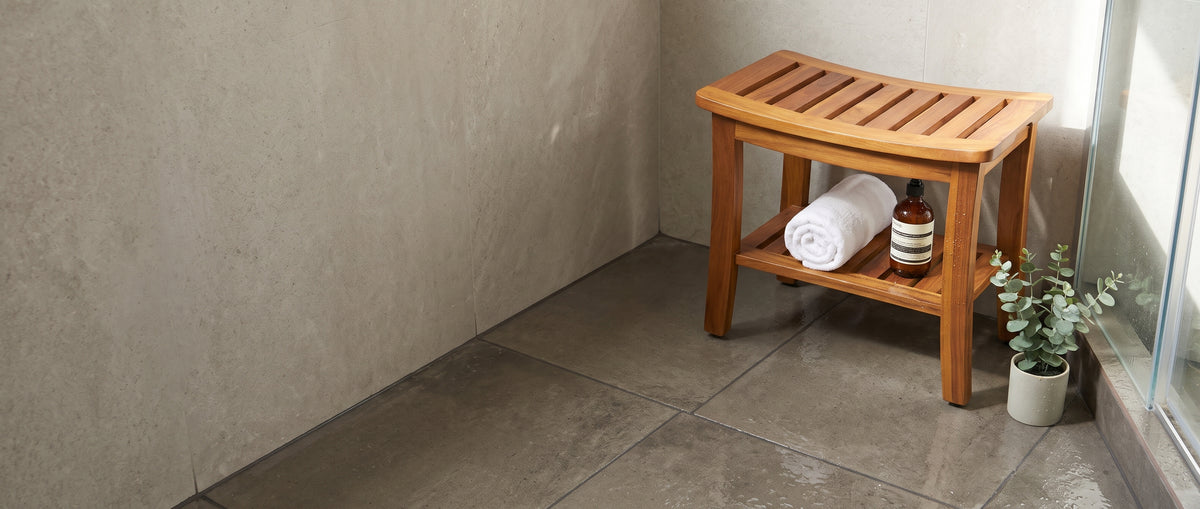
Type "teak shower bench" into any marketplace and you will see dozens of benches that look the same in photos, with prices that differ by hundreds of dollars. Some are solid teak. Many are not. Their listings may say "teak finish," "teak color," "teak oil finish" or simply "teak style," and those words do not mean the same thing as "solid teak."
The difference matters most in a shower, where the wood gets wet every day. Solid teak's natural oils and dense heartwood are what let it handle water. A different wood with a teak-colored coating can look identical on day one and behave very differently a few months later.
This guide decodes the terms you will see, explains why the difference matters, and gives you practical checks for spotting real solid teak, both online and in person.
The short answer
- "Solid teak" means the piece is made from teak wood (Tectona grandis) all the way through.
- "Teak finish," "teak color" or "teak stain" usually describes a color or coating applied to another wood, such as rubberwood, acacia, pine or eucalyptus.
- "Teak oil" or "teak oil finish" describes a type of oil finish that can be applied to any wood. It does not mean the wood is teak.
- "Teak veneer" means a thin layer of real teak glued over another material, such as plywood or MDF.
- "Teak-look" or "teak style" describes appearance only.
To be sure, look for clear wording such as "100% solid teak," then check the weight, grain, end grain, feel and price.
Teak terms decoded
| Listing term | What it usually means | Is the wood teak? | How it behaves in a shower |
|---|---|---|---|
| Solid teak / 100% solid teak | Made entirely from teak wood | Yes | Naturally water- and decay-resistant |
| Solid Indonesian teak | Solid teak grown in Indonesia | Yes | As above |
| Teak (no other detail) | Often teak, but ambiguous | Ask | Check the materials line |
| Teak veneer | Thin teak layer over another core | Only the surface | Core can swell or delaminate if water gets in |
| Teak finish / teak color / teak stain | Another wood colored to look like teak | No | Depends on the base wood and coating |
| Teak oil finish | Oil product applied to any wood | Not necessarily | Depends on the base wood |
| Teak-look / teak style | Appearance only | No | Depends on the material |
| Teakwood (one word) | Usually teak, but sometimes used loosely | Ask | Check the materials line |
Some product listings use these terms carefully and some do not. When a listing is vague, ask the seller directly: "What species is this wood, and is it solid throughout?"
Why the difference matters in a shower
Water resistance comes from inside the wood
Teak heartwood contains natural oils and extractives that make it resistant to moisture and decay. Timber authorities rate it in their highest durability class for above-ground use; the Business Queensland timber guide, for example, lists teak as Class 1 above ground and resistant to termites. That resistance is a property of the wood itself, so it does not disappear when the surface wears.
A teak-colored coating on another wood works differently. The protection, if any, sits in the coating. Once a shower wears through it, which is easy at slat edges and corners, water reaches a wood that may not resist it well.
Movement and joints
Teak moves relatively little as humidity changes, so joints stay tight through daily steam and drying. Many cheaper woods move more, which can loosen joints and open cracks in a bathroom.
Veneer and water do not mix well
Veneer is a legitimate technique in furniture, and it can be beautiful indoors. In a shower, though, the glue line and the core material are vulnerable. If water gets under the veneer at an edge or a scratch, the core can swell and the veneer can lift.
Care is different
Solid natural teak can be lightly sanded and oiled to restore its color, because the same wood runs all the way through. A stained or veneered piece cannot be sanded the same way without exposing a different color or wood underneath. Our guide to restoring a weathered teak shower bench explains the process for solid teak.
Value
Solid teak costs more because it is a dense, slow-growing hardwood. Paying a solid-teak price for a teak-finished bench is the outcome you want to avoid.
None of this means teak is waterproof. No wood is. Teak is naturally water-resistant, which is a meaningful difference. Our guide to whether a teak shower bench is waterproof explains why.
How to check a listing online
Most people buy shower benches online, so start with the listing.
1. Read the materials line, not just the title. Titles are often written for search. The specifications or materials section is where sellers state what the product is made from. Look for a named species: "Material: solid teak" or "100% solid Indonesian teak."
2. Watch for qualifiers. "Finish," "color," "style," "look," "stain," "oil" and "veneer" after the word teak all change the meaning.
3. Check the product weight. Teak is dense, at about 670 kilograms per cubic meter at 12% moisture content. A solid-teak bench should feel substantial for its size. A suspiciously light weight for a large bench is worth a question.
4. Look closely at the photos. Zoom in on the ends of the slats and legs. Solid wood shows the same grain on the face and the end grain. Veneer may show a thin top layer over a different core. A uniform, flat color with no visible grain can suggest a heavy stain or paint.
5. Compare prices. A solid-teak bench at a fraction of the price of comparable solid-teak benches deserves a closer look at the materials.
6. Look for sourcing details. Sellers of solid teak often say where the wood comes from. Several TeakCraft listings, including the 30-inch Freya teak shower bench, describe the wood as SVLK-certified legal Indonesian teak.
7. Read the care instructions. Instructions to oil and lightly sand a natural-teak bench suggest solid wood. Instructions never to sand a finished surface are normal for colored finishes, including TeakCraft's rustic gray, which is applied over solid teak.
8. Ask. A reputable seller will tell you the species, whether it is solid, and where it was made.
For a full pre-purchase checklist, see our guide to choosing the best teak shower bench.
How to check a piece in person
If you can handle the bench, in a store or after delivery, these checks add up to a strong indication. No single test is proof on its own; look at them together.
1. Color and grain
Natural teak heartwood is golden-brown to medium brown, sometimes with darker streaks. Its grain is usually straight, sometimes slightly wavy, and varies naturally from board to board. Over time and with light, it softens toward silver-gray.
Watch for: perfectly uniform color across every board, a painted look with no grain visible, or orange or red tones that look applied rather than natural.
2. End grain
The end grain is the cut end of a board, such as the bottom of a leg or the end of a slat. On solid wood, the end grain matches the color of the faces and shows the growth rings running through. On veneer over plywood, you may see layered plies; over MDF or particleboard, you will see a uniform compressed core. A thin stripe of a different color at the edge can indicate veneer or a surface stain.
3. Weight
Pick it up. Solid teak is dense and feels heavier than most furniture woods of the same size. An unexpectedly light bench may be a lighter species or hollow construction.
4. Feel
Unfinished or oiled natural teak often has a slightly oily or waxy feel. A thick varnish or lacquer feels like smooth plastic and may look glossy.
5. Water behavior
On natural, oiled teak, a few drops of water tend to bead and sit on the surface. On many unfinished softwoods, water soaks in more quickly and darkens the wood. This is only a rough indicator, because finishes on any wood change how water behaves.
6. Scent
Freshly cut or sanded teak has a distinctive, slightly leathery scent that people who work with it often recognize. On a finished bench, though, this is a weak test.
7. Hidden-spot check
On the underside, look at any area where the finish may be thin, such as a screw hole or a sanded edge. Is the wood beneath the same color as the surface? A different color underneath suggests a stain or a veneer.
8. Construction details
Solid teak benches are usually built with solid slats and legs, joined with wood joinery and stainless or corrosion-resistant hardware. Particleboard, MDF or plywood components are signs that a piece is not solid teak.
What about teak grades and origins?
You may see listings that mention "Grade A teak," "premium teak" or "plantation teak."
Grades. Retailers commonly use letter grades to describe how much of a board is heartwood versus sapwood and how clean the grain is. There is no single universal grading standard that all sellers follow, so a grade on one website may not mean the same as on another. What matters more is whether the wood is mostly heartwood, which is the durable part. Research from the Swedish University of Agricultural Sciences found plantation teak's outer heartwood very durable, while sapwood rated only moderately durable.
Plantation teak. Much of the teak sold today comes from managed plantations, including in Indonesia. The SLU study found that heartwood from young plantation teak still met expectations for very high natural durability.
Legality and SVLK. Indonesia runs a national timber legality assurance system called SVLK, designed to verify that timber is legally harvested and traded. Indonesia's licensed exports have been recognized under the European Union's FLEGT licensing scheme since 2016. Independent monitors, including a 2022 evaluation by Indonesian civil-society groups, have criticized gaps in how the system is enforced. A legality certificate is meaningful, but it is not the same as an environmental or sustainability certification, so read what any certification covers.
Solid teak vs teak-finished wood at a glance
| Feature | Solid teak | Teak finish on another wood | Teak veneer |
|---|---|---|---|
| Wood all the way through | Teak | Another species | Another core with a thin teak skin |
| Natural water and decay resistance | High (heartwood) | Depends on the base wood | Surface only |
| Weight | Heavy for its size | Varies, often lighter | Varies |
| End grain | Matches the faces | Matches the base wood, not teak | Shows layers or a core |
| Can be sanded and re-oiled | Yes, on natural teak | Sanding exposes a different wood | Only very lightly, if at all |
| Typical price | Highest | Lower | Lower to moderate |
| Best use in a shower | Excellent | Limited, depends on finish | Not recommended |
Weighing other materials too? See teak vs bamboo for wet showers and our teak vs plastic vs aluminum comparison.
Caring for solid teak vs finished wood
Care instructions depend on what the piece is made of.
- Natural solid teak: rinse after use, wash with mild soap every few weeks, oil thinly every two to three months if you want to keep the color, and lightly sand along the grain with 220-grit paper to remove stubborn spots or restore the color.
- Solid teak with a colored finish, such as TeakCraft's rustic gray: same routine, but do not sand. Sanding removes the finish.
- Teak-finished other woods: follow the manufacturer's instructions. Do not sand unless they say you can, and expect to refresh the finish when it wears.
- Veneer: keep water away from edges, avoid soaking, and do not sand through the thin top layer.
TeakCraft's teak shower bench care guide gives the full routine for natural and rustic gray benches.
Beyond the bathroom
The same checks apply to teak patio furniture, benches and tables, where teak finishes on other woods are also common. TeakCraft's outdoor pieces, such as those in the outdoor seating collection and the 39.5-inch Capella solid teak bench, list their materials on each product page.
Why solid teak costs more
If you are comparing prices, it helps to know where the cost of a solid teak bench comes from.
- The wood itself. Teak is a slow-growing tropical hardwood. Usable heartwood takes years to develop, and only part of each log is suitable for furniture.
- Density and weight. A dense wood means more material per bench and higher shipping weight.
- Machining. Teak contains natural silica, which the Business Queensland timber guide notes causes severe blunting of cutting edges. Tools wear faster and need more frequent sharpening or carbide tips.
- Hand finishing. Quality benches are sanded, assembled and checked by hand.
- Legal sourcing. Documented, legally sourced timber carries compliance costs.
A teak-finished bench made from a faster-growing, softer wood avoids most of these costs, which is why it can sell for much less.
Questions to send a seller
If a listing is unclear, copy and adapt these questions. A trustworthy seller should be able to answer them quickly.
- What wood species is this bench made from?
- Is it solid wood throughout, or does it use veneer, plywood, MDF or other composite parts?
- If it is teak, is it mostly heartwood?
- Where was the wood grown, and can you share any legality or sourcing documentation?
- Is there any finish on the surface? If so, what is it, and how should it be maintained?
- What hardware is used, and is it stainless steel?
- What is the weight rating, and what are the exact dimensions, including seat height?
- Does it arrive assembled?
- What are the care instructions?
- What is your return policy if the product is not as described?
Vague or evasive answers to the first three questions are a strong signal to keep looking.
Common listing patterns to read carefully
You will see many honest listings that describe their products clearly. These patterns are simply worth a second look.
| What you see | What to do |
|---|---|
| "Teak" in the title, a different species in the specifications | Trust the specifications; the title may be written for search |
| "Teak" with no species or "solid" anywhere in the details | Ask the seller to confirm the material |
| Photos with a perfectly uniform color on every board | Ask whether a stain or paint has been applied |
| A very low price compared with other solid-teak listings | Check the materials line and weight carefully |
| No care instructions | Ask; care advice reveals a lot about the material |
| Claims of "waterproof" or "mold-proof" wood | Treat as overclaiming; no wood is either |
| Reviews mentioning peeling, swelling or color rubbing off | Signs of a coating over another material |
A note on reclaimed and recycled teak
Some furniture is made from reclaimed teak, salvaged from old buildings, boats or furniture. Reclaimed teak can be genuine solid teak with beautiful character, but quality varies. It may include old nail holes, mixed boards or patches. Ask the same questions about species, solidity and hardware, and check whether the wood has been cleaned and finished for wet use.
Frequently asked questions
What does "teak finish" mean?
It usually means a teak-like color or coating applied to another wood. It does not mean the furniture is made of teak.
Is "teak oil" the same as teak wood?
No. Teak oil is a finishing oil that can be used on many woods. A piece described as having a "teak oil finish" may not be teak.
Is teak veneer good for a shower?
Generally no. Veneer is a thin layer over another material, and water can get under it at edges and scratches.
How can I tell if my bench is solid teak?
Check the listing's materials line, then look at the end grain, weight, color variation and feel. If the end grain matches the faces, the bench is heavy for its size and the color varies naturally, it is likely solid wood. Ask the seller to confirm the species.
Are TeakCraft benches solid teak?
Yes. TeakCraft shower benches are made from solid Indonesian teak. The rustic gray models have a hand-applied gray finish over solid teak.
Is darker teak better quality?
Not necessarily. Heartwood is darker than sapwood, but color also varies with growing conditions, age, finish and exposure to light. Look at the full picture, not color alone.
The bottom line
The word "teak" in a product title does not always mean teak wood. "Solid teak" names the material; "teak finish," "teak color," "teak oil" and "teak-look" usually describe a surface. For a shower bench, where water resistance comes from the wood itself, that difference matters. Read the materials line, check the end grain and weight, ask questions, and be wary of solid-teak claims at a fraction of solid-teak prices.
Shopping for the real thing? Every bench in TeakCraft's teak wood shower bench collection is made from solid Indonesian teak and arrives fully assembled. The 24-inch Eske is a good place to start.
Share:
How to Restore a Weathered Teak Shower Bench
Small Shower Storage Ideas That Don't Require Drilling