


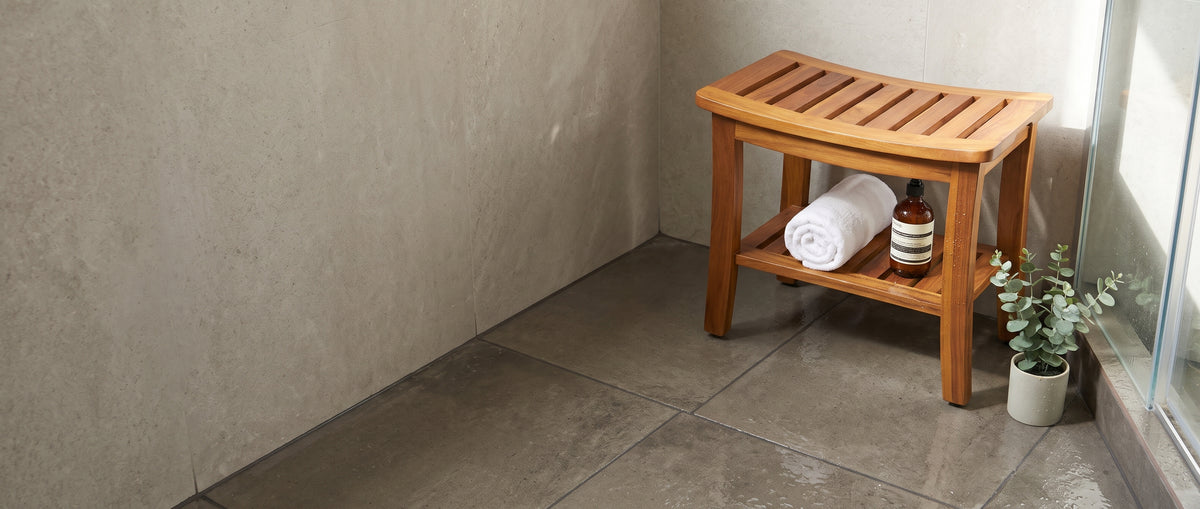
If your teak shower bench has developed a cloudy white film, chalky rings where bottles sit, or a dull, slightly sticky surface, you are probably looking at soap scum, hard-water minerals or a mix of both. The good news: on solid teak these deposits sit on the surface, and they can usually be removed with mild soap, a soft brush, diluted white vinegar and patience.
This guide shows you how to tell what kind of residue you have, how to remove it without damaging the wood, how to handle stubborn spots, and how to stop it from coming back. For everyday washing and mildew care, see our main guide to cleaning a teak wood shower bench.
The quick method
- Rinse the bench with warm water.
- Wash with a few drops of mild dish soap in warm water and a soft-bristle brush, moving along the grain.
- For white mineral film that remains, wipe or brush on a mix of 1 part white vinegar to 4 parts warm water. Let it sit for a few minutes, then scrub gently along the grain.
- Rinse thoroughly with clean water.
- Let the bench dry completely, ideally for a full day with the bathroom fan running.
- On natural teak, finish with a thin coat of teak oil once dry, wipe off the excess and let it cure for 24 hours.
That routine handles most cases. The rest of this article explains each step, what to do when deposits will not budge, and what never to use.
What you are actually looking at
Different residues need slightly different treatment, so start by identifying yours.
| What it looks like | What it probably is | Where it shows up |
|---|---|---|
| Dull, gray-white film that feels slick or tacky | Soap scum: soap and body oils combined with water minerals | Seat slats, top of the shelf |
| White, chalky rings or crusty spots that feel gritty | Hard-water mineral deposits, mostly calcium carbonate | Under bottles, edges where drips dry |
| Cloudy patches after the bench dries | Thin mineral film from evaporating water | Anywhere water sits and dries |
| Black or dark gray specks | Mildew growing on residue | Between slats, joints, underside |
| Even silver-gray color on natural teak | Normal weathering, not a stain | All exposed surfaces |
If the color is an even silver-gray rather than patchy white, you are seeing teak's natural patina, not a deposit. That is a different job, covered in our guide to restoring a weathered teak shower bench.
Why soap scum and hard-water marks form on teak
The US Geological Survey defines hard water as water high in dissolved minerals, mainly calcium and magnesium. It classifies water above 120 milligrams per liter of hardness as hard, and above 180 as very hard. Many US communities have hard or very hard water; your local water utility's annual quality report lists yours.
Two things happen in a hard-water shower.
Soap scum forms. Calcium in hard water reacts with soap. USGS notes that this reaction creates soap scum, the same film that clouds glass shower doors. On a bench, it builds up on the slats where suds land and are not rinsed away.
Minerals are left behind as water evaporates. Every drop that dries on the bench leaves a tiny amount of mineral behind. Over weeks, those layers become visible white rings, especially under bottles that trap water.
Teak's natural oils help water bead and run off, which slows buildup compared with more absorbent woods. But no material is immune. Glass, tile, chrome and plastic all collect the same residue.
What you need
You probably have everything already.
- Mild, fragrance-free dish soap
- Distilled white vinegar (standard 5% household strength)
- A bucket or spray bottle
- A soft-bristle brush, such as a soft nylon scrub brush or an old soft toothbrush for the gaps between slats
- Soft, lint-free cloths or microfiber towels
- Fine sandpaper (220 grit), for natural teak only and only if needed
- Teak oil, if you oil your bench
- Gloves, if you have sensitive skin
For safety, never mix vinegar with bleach or with cleaners that contain bleach or ammonia. Mixing chemical cleaners can release harmful gases.
Step-by-step: removing soap scum from teak
Start with the gentlest method and only step up if you need to.
Step 1: Rinse and loosen
Rinse the whole bench with warm water. Warm water softens soap film and makes it easier to lift. If the bench is in a tight spot, move it out of the shower so you can reach every side, including the underside of the seat and the shelf.
Step 2: Wash with mild soap
Mix a few drops of mild dish soap into a bucket of warm water. Dip a soft-bristle brush and scrub along the grain of each slat. Work methodically: top of the seat, edges, gaps between slats, legs, shelf and underside.
It seems backward to remove soap with soap, but mild dish soap is designed to lift oils and residues, and it rinses away cleanly. Many cases of light soap scum come off at this stage.
Step 3: Rinse thoroughly
Rinse with plenty of clean water so no soap is left behind. Leftover cleaning solution is exactly what you are trying to remove.
Step 4: Check in good light
Let the surface dry for a few minutes and look at it under good light. Run your fingers across the slats. If the surface feels clean and the white film is gone, skip to drying. If cloudy patches or chalky rings remain, they are likely mineral deposits. Move to the vinegar step.
Step-by-step: removing hard-water stains from teak
White vinegar is a mild acid, and acids dissolve calcium carbonate, the main component of hard-water scale. TeakCraft's own care guide recommends a diluted vinegar solution for mildew on teak benches, and the same mix works on light mineral film.
Step 5: Apply diluted vinegar
Mix 1 part white vinegar with 4 parts warm water. Apply it with a spray bottle or a cloth to the affected areas.
Step 6: Give it a few minutes
Let the solution sit for three to five minutes. Do not let it dry on the surface. On thick deposits you may see the white areas soften or start to fade.
Step 7: Scrub gently along the grain
Use the soft brush, moving with the grain. Use the toothbrush for gaps between slats and around joints, where scale tends to collect. Avoid scrubbing hard across the grain, which can raise the wood fibers.
Step 8: Rinse well
Rinse thoroughly with clean water to remove all vinegar and dissolved minerals. Vinegar left on the wood is not helpful.
Step 9: Repeat if needed
Thick buildup may need two or three rounds. Repeating a gentle treatment is better for the wood than one aggressive one.
Step 10: Dry completely
This step matters as much as the cleaning. Stand the bench where air can move around it, leave the shower door open and run the exhaust fan. If you can, give it a full day before the next shower. A bench that goes back into service damp starts collecting residue again immediately.
Step 11: Re-oil natural teak (optional)
Vinegar and scrubbing remove some of the oils at the surface. Once the bench is completely dry, you can apply a thin, even coat of teak oil with a soft cloth, working along the grain. TeakCraft recommends wiping off all excess after about 15 minutes and letting the bench cure for 24 hours before using it, so the seat is not slippery. A light coat also helps the next round of water bead and run off.
When deposits will not come off
If white marks remain after two or three vinegar treatments, work through these options in order.
Try a longer contact time. Lay a cloth soaked in the 1:4 vinegar solution over the spot for 10 to 15 minutes, keeping it damp, then scrub gently and rinse well.
Focus on the gaps. Scale often hides along the edges of slats and in joints. A soft toothbrush or a wooden craft stick wrapped in cloth reaches where a brush cannot. Avoid metal picks that can gouge the wood.
Lightly sand natural teak. Solid teak is the same wood all the way through, so a light sanding reveals fresh wood beneath a stubborn surface stain. Use 220-grit sandpaper, sand only along the grain, keep the pressure light and stop as soon as the mark is gone. Wipe off the dust, then oil the bench once it is dry.
Do not sand a rustic gray bench. TeakCraft's rustic gray benches, such as the 21-inch Lavici shower bench, have a hand-applied gray finish over solid teak. Sanding removes that finish. Stick to soap, diluted vinegar and patience, and spot-test any solution on the underside of the bench first.
Accept a faint shadow. Very old deposits can leave a faint outline even after cleaning. On natural teak it usually blends in after the next oiling or as the wood ages.
What not to use on teak
Many bathroom cleaners are built for tile, glass and chrome, not wood. These can damage teak or its finish.
| Avoid | Why |
|---|---|
| Bleach and bleach-based sprays | Can strip natural oils and leave blotchy, uneven color |
| Ammonia-based cleaners | Harsh on wood and dangerous to mix with other cleaners |
| Strong acid descalers and lime-and-rust removers | Formulated for hard surfaces; can etch, darken or dry out wood unless the label says wood-safe |
| Steel wool and scouring pads | Scratch and raise the grain; steel wool can leave particles that stain |
| Abrasive powders and melamine sponges | Act like fine sandpaper and can scuff finishes |
| Pressure washers | Too aggressive; they tear up the wood surface |
| Undiluted vinegar left to soak for hours | More acid than you need; dilute and rinse |
When in doubt, use less: milder solution, softer brush, more rinsing.
Cleaning teak accessories: shelves, caddies and mats
The same method works on other teak bath accessories, with a few adjustments.
- Shelves. On a teak shower shelf like the 3-tier Om corner shelf, mineral rings form under bottles. Lift everything off each week, rinse the shelves and let them dry before putting bottles back.
- Caddies. A teak shower caddy holds wet bottles, soap and razors close together, which traps water. Empty it, wash it with mild soap, use the vinegar mix on rings and dry it fully.
- Mats. A teak bath mat collects soap that drips off your body. Stand it on its edge to dry after each use so water does not sit underneath, and wash it every couple of weeks.
How to prevent soap scum and hard-water marks
Prevention takes less time than removal.
- Rinse the bench at the end of every shower. A ten-second spray of clean water removes soap before it bonds with minerals.
- Wipe off standing water. If your water is very hard, a quick wipe of the seat and shelf with a towel stops drops from drying into rings.
- Do not store bottles on the seat. Bottles trap water and leave rings. Use a shelf or caddy, and lift bottles regularly.
- Ventilate. Run the bathroom fan during and for 15 to 20 minutes after your shower, and leave the door or curtain partly open.
- Wash every few weeks. A mild-soap wash keeps film from building into something harder to remove.
- Oil natural teak periodically. A thin coat every two to three months helps water bead and run off.
- Consider your water. If you also fight scale on glass, fixtures and your water heater, a water softener or a showerhead filter may reduce buildup across the bathroom. Results vary by system and water chemistry.
These habits also protect the bench over the long run. Our guide to how long a teak shower bench lasts explains why moisture and residue are the main factors you control.
Find out how hard your water is
Knowing your water hardness helps you decide how often to descale. There are three easy ways to find out.
- Check your utility's water quality report. Most US public water systems publish an annual report, often called a Consumer Confidence Report. Many list hardness, usually in milligrams per liter (mg/L) or grains per gallon. One grain per gallon is about 17.1 mg/L.
- Use test strips. Inexpensive water hardness test strips from hardware stores give a quick reading at home.
- Look for clues. White crust on faucets and showerheads, spotty glassware and soap that does not lather well are all signs of hard water.
Once you know your number, use the USGS categories as a guide:
| Hardness (mg/L as calcium carbonate) | USGS category | How often to check your teak for mineral film |
|---|---|---|
| 0 to 60 | Soft | Rarely; routine soap washes are usually enough |
| 61 to 120 | Moderately hard | Every couple of months |
| 121 to 180 | Hard | Monthly |
| Over 180 | Very hard | Every two to four weeks, plus a quick wipe after showers |
The right-hand column is a practical starting point, not a rule. Adjust it to what you actually see on your bench.
A five-minute weekly routine for hard-water homes
If you live with hard or very hard water, this short weekly routine keeps deposits from ever becoming a project.
- Clear the bench and shelf. Move bottles, razors and loofahs off.
- Rinse everything. A warm-water rinse loosens fresh residue.
- Spot-treat rings. Spray the 1:4 vinegar mix only where you see white marks, wait three minutes, and brush gently along the grain.
- Rinse again. Make sure no vinegar is left behind.
- Wipe dry. A quick towel wipe stops new drops from drying into rings.
- Put things back with gaps. Leave space between bottles so air can reach the wood.
Do the full mild-soap wash every two to four weeks, and the routine above in between.
Special cases and tricky stains
Not every mark on a teak bench is soap scum or minerals. Here is how to handle a few other common ones.
Orange or brown spots near metal. Razors, metal caddies, hair clips and cans left on the bench can leave rust marks. Remove the metal object first. Clean the spot with mild soap and the diluted vinegar mix. On natural teak, a stubborn rust shadow can often be lightened with careful 220-grit sanding along the grain. Avoid this on rustic gray finishes.
Dark rings under bottles. Bottles trap water against the wood, which can darken it locally. Clean the area, let the bench dry fully, and keep bottles on a shelf or caddy with airflow underneath.
Colored stains from products. Hair dye, self-tanner and some body scrubs can tint wood. Rinse immediately. If a stain sets on natural teak, light sanding may remove it. On rustic gray benches, gentle cleaning is the safe limit.
Pink or orange film. In many showers, a pink or orange film appears on surfaces that stay damp. It is commonly associated with airborne bacteria that thrive on soap residue in damp areas. Clean it with mild soap, rinse, and improve drying and ventilation so it does not return.
Waxy buildup after oiling. If too much teak oil was left on the surface, it can feel tacky and trap dirt. Wipe firmly with a clean, dry cloth. Next time, wipe off all excess about 15 minutes after applying.
Cleaning teak used outdoors or by the pool
TeakCraft benches are labeled for indoor and outdoor use, so some owners move a bench to a patio, pool deck or outdoor shower. Outdoors, the residues change.
- Pool water. Rinse with fresh water after the bench is splashed with chlorinated water, then let it dry.
- Sunscreen and body oils. These can leave dark marks on seat slats. A mild-soap wash removes most of them.
- Pollen and leaves. Brush them off regularly so they do not hold moisture or stain the wood.
- Sprinkler water. Garden sprinklers using hard water can leave mineral spots just like a shower. Move the bench out of the spray if you can.
Cleaning myths that can damage teak
"Bleach is the best way to kill mildew." On teak, bleach can strip natural oils and leave blotchy color. TeakCraft recommends diluted white vinegar for mildew instead.
"Stronger cleaners work faster." Strong acid descalers and alkaline cleaners are formulated for tile and glass. On wood they can etch, darken or dry out the surface.
"A pressure washer gets into the gaps." It also tears up the wood surface and raises the grain. A soft toothbrush reaches the gaps without damage.
"More oil means more protection." Thick coats sit on the surface, stay sticky and attract grime. Thin coats, with the excess wiped off, work better.
"If it's teak, it never needs cleaning." Teak resists water and decay, but soap and minerals still land on it. A rinse and the occasional wash keep it looking good.
Your cleaning schedule at a glance
| When | What to do |
|---|---|
| After every shower | Rinse with clean water; leave the door open; run the fan |
| Weekly (hard water) | Lift bottles, spot-treat rings with diluted vinegar, rinse, wipe dry |
| Every 2 to 4 weeks | Full mild-soap wash with a soft brush, rinse, dry |
| Every 2 to 3 months | Thin coat of teak oil on natural or rustic gray teak, wiped off and cured 24 hours |
| As needed | Light 220-grit sanding of stubborn spots on natural teak only |
Frequently asked questions
Can I use vinegar on a teak shower bench?
Yes, diluted. TeakCraft recommends 1 part white vinegar to 4 parts warm water, applied with a soft brush and rinsed off thoroughly. Spot-test first on rustic gray or other finished teak.
Can I use baking soda on teak?
Baking soda is mildly abrasive. A light paste may help on stubborn residue on natural teak, but scrub gently along the grain, rinse well and avoid it on rustic gray finishes. Start with soap and diluted vinegar.
Why does my teak bench feel sticky after cleaning?
Soap residue was not fully rinsed, or excess teak oil was not wiped off. Rinse again with clean water. If you oiled the bench, buff with a clean cloth and let it cure for 24 hours.
Will hard water damage teak?
Hard water mostly causes surface deposits rather than damage to the wood itself. Left for a long time, heavy buildup can trap moisture and dull the surface, so remove it when you notice it.
How often should I descale my teak bench?
Only when you see white film or rings. In very hard water that may be monthly; in softer water, rarely.
Can I use a commercial shower cleaner on teak?
Only if the label says it is safe for wood and you have tested it on a hidden spot. Most shower cleaners are made for tile and glass.
The bottom line
Soap scum and hard-water marks are a nuisance, not a disaster. On solid teak they sit on the surface and come off with mild soap, diluted white vinegar, a soft brush and a thorough rinse and dry. Skip the bleach, harsh descalers and scouring pads, and do not sand rustic gray finishes. Then make rinsing and ventilation a habit, and the white film will stay away.
Looking for a bench that is easy to keep clean? Every bench in TeakCraft's teak shower bench collection has a slatted seat that drains quickly, is made from solid Indonesian teak and arrives fully assembled. A natural-teak option like the 24-inch Eske shower bench is a good fit for standard showers.
Share:
How Long Does a Teak Shower Bench Last Inside a Shower?
Why Teak Is One of the Best Woods for Wet Bathrooms (and Is It Waterproof?)