


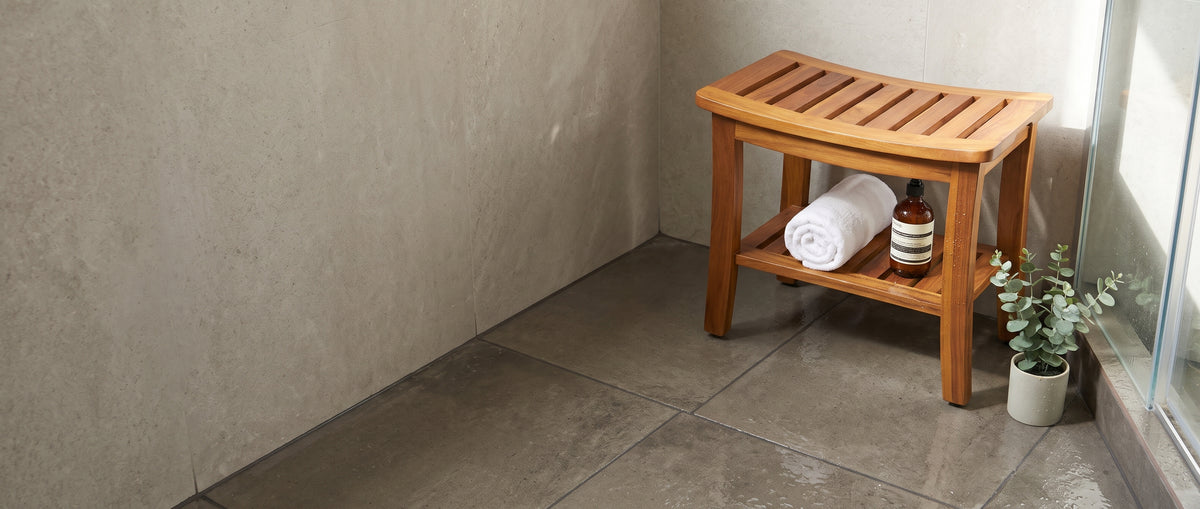
A teak shower bench is an investment, so it is fair to ask how long it will last before you buy one. The honest answer is that there is no single number. A solid teak bench that is well built, rinsed after use and kept in a ventilated bathroom can stay in daily service for many years. The same bench in a windowless bathroom with no fan, coated in soap film and never allowed to dry, will show wear much sooner.
This guide explains what makes teak durable, what shortens or extends a bench's life in a shower, how teak compares with other materials, and the signs that tell you whether a bench needs cleaning, repair or replacement.
The short answer
- Teak heartwood is one of the most naturally durable woods available. Government timber guides rate it in their highest durability class for above-ground use.
- Your bench's real lifespan depends on five things: the quality of the teak, how the bench is built, how wet your bathroom stays, how often you rinse soap off it, and the condition of its feet and joints.
- Most problems are surface problems. Graying, dark mildew spots and a slick film usually come from soap residue and moisture on the surface, not from the wood breaking down. They can be cleaned.
- A bench should be replaced when the structure is compromised: cracked legs, loose joints that cannot be tightened, soft or crumbling wood, or a wobble you cannot fix.
No manufacturer can honestly promise that a wood product will last a fixed number of years in every bathroom. What you can do is buy well and look after it, and the rest of this guide shows you how.
Why teak lasts longer than most woods in wet rooms
Teak (Tectona grandis) is a tropical hardwood native to South and Southeast Asia. Builders have used it for ship decks, outdoor furniture, saunas and bathroom fittings for centuries because it copes with water better than most timbers.
Three properties explain its reputation.
1. Natural decay resistance. Teak heartwood contains natural oils and extractives that make it hard for decay fungi to break the wood down. The Business Queensland timber guide rates teak's above-ground durability as Class 1, the highest class in that system, which it describes as a life expectancy of more than 40 years for above-ground timber outdoors. That rating describes the timber species in general use outdoors, not any particular bench, but it shows why teak is chosen for wet conditions.
2. Dimensional stability. Wood swells when it absorbs moisture and shrinks as it dries. That constant movement is what loosens joints and opens cracks in cheaper wooden benches. Teak moves relatively little. The same Queensland guide lists its shrinkage from green to 12% moisture content at 2.2% tangential and 1.2% radial, which is low for a hardwood.
3. Density and strength. At roughly 670 kilograms per cubic meter at 12% moisture content, teak is dense enough to support adult weight on relatively slim slats and legs without flexing.
There is an important qualifier. These properties belong to teak heartwood, the darker inner wood of the tree. Teak sapwood, the paler outer layer, is far less durable. Researchers at the Swedish University of Agricultural Sciences tested plantation teak against decay fungi and found the outer heartwood very durable, while the sapwood rated only moderately durable. A bench made with a lot of sapwood, or from a different wood stained to look like teak, will not last like solid teak heartwood.
What shortens a teak bench's life in the shower
Most common issues with a teak shower bench come back to one of these causes.
Constant moisture with no chance to dry
Teak resists water, but it is not waterproof, and no wood is. A bench that stays wet for days at a time gives mildew a chance to grow on the surface and keeps the wood swelling and shrinking. The US Environmental Protection Agency's mold guidance is clear that moisture control is the key to mold control, and it recommends venting bathrooms and keeping indoor humidity below 60%, ideally between 30% and 50%.
Practical signs your bathroom is too wet for long-term health of any furniture: mirrors stay fogged long after a shower, paint or grout shows mildew, or towels never fully dry.
Soap film and body oils
Soap, shampoo, conditioner and body wash leave a film on any surface in the shower. On teak, that film holds moisture against the wood and feeds mildew. In hard-water areas, minerals in the water combine with soap to create soap scum that is harder to remove. Rinsing the bench with clean water at the end of each shower is the single most effective habit for keeping it in good condition.
Harsh cleaners and tools
Bleach, ammonia, abrasive powders, steel wool and pressure washers can strip teak's natural oils, raise the grain and leave a rough, blotchy surface that collects grime faster. TeakCraft's care instructions recommend mild soap and a soft brush instead.
Standing water under the feet
Water that pools around the feet of a bench keeps the end grain of the legs wet. End grain absorbs water more readily than the face of a board. Benches with raised rubber feet help, and so does placing the bench where water drains away rather than sitting in a low spot.
Overloading and rough handling
Every bench has a weight rating. Most TeakCraft shower benches are rated to 350 pounds, and the heavy-duty Elera and Danica are rated to 400 pounds. Standing on a bench, rocking on two legs or dropping heavy objects on the slats stresses joints well beyond normal sitting.
Poor-quality construction
Thin slats, weak joints, low-grade hardware and mixed woods shorten a bench's life no matter how carefully you treat it. A well-built bench uses solid teak throughout, joints designed for wet conditions and corrosion-resistant hardware. Our guide to the best teak shower bench covers what to inspect before you buy, and our guide to telling solid teak from teak-finished wood explains how to spot a lookalike.
What helps a teak bench last longer
The habits that extend a bench's life are simple and take less than a minute on most days.
- Rinse after every shower. A quick spray of clean water removes soap before it dries into a film.
- Let it dry. Leave the shower door or curtain partly open and run the exhaust fan for 15 to 20 minutes after bathing. Avoid draping wet towels over the bench.
- Wash every few weeks. Use a few drops of mild dish soap in warm water and a soft brush, working along the grain and between the slats.
- Oil occasionally if you want to keep the color. TeakCraft recommends a thin coat of teak oil every two to three months, wiped off after about 15 minutes and left to cure for 24 hours before the next shower.
- Check the feet and joints. Every few months, make sure the bench sits level without rocking. Replace cracked or worn feet.
- Keep the floor around it draining. A teak shower mat outside the shower gives you a dry place to step and keeps puddles away from bathroom furniture.
For full step-by-step instructions, including how to treat dark mildew spots, see our complete guide to caring for a teak shower bench.
Signs of wear, and what each one means
Not every change in your bench means it is wearing out. Use this table to decide whether you are looking at a cleaning job, a repair or a replacement.
| What you see | What it usually means | What to do |
|---|---|---|
| Silver-gray color on natural teak | Normal weathering of the surface from water and light | Leave it as a patina, or clean, lightly sand and oil to restore the honey tone |
| Slick or sticky feel | Soap and body-oil film | Wash with mild soap and a soft brush; rinse after each use |
| Small black or dark spots | Mildew growing on surface residue | Scrub with diluted white vinegar (1 part to 4 parts water); improve ventilation |
| White, chalky or cloudy patches | Hard-water minerals and soap scum | See our guide to removing soap scum and hard-water stains from teak |
| Rough, raised grain | Harsh cleaners, scrubbing against the grain, or repeated wetting | Light sanding with fine paper on natural teak; switch to gentle cleaning |
| Bench rocks on the floor | Worn foot, uneven floor or loose joint | Adjust or replace the feet; check joints |
| Fine surface checks (hairline cracks) | Drying stress, often after long dry spells | Usually cosmetic; oil helps; monitor for growth |
| Deep crack through a leg or rail | Structural damage | Stop using the bench and contact the seller or replace it |
| Wood feels soft or crumbles | Decay, usually from long-term trapped water | Replace the bench |
| Loose joint that will not tighten | Joint failure | Stop using it until repaired; replace if it cannot be fixed safely |
If the gray look bothers you, our step-by-step guide to restoring a weathered teak shower bench explains how to bring back the color on natural teak. One caution: TeakCraft's rustic gray benches have a hand-applied gray finish, so do not sand them; sanding will remove the finish.
For white mineral marks, our guide to removing soap scum and hard-water stains from teak walks through gentle methods that will not damage the wood.
How teak compares with other shower bench materials
Lifespan is relative. Here is how teak's durability compares with the alternatives most people consider.
Plastic. Plastic does not rot, but many plastics become brittle, scratched and discolored over time, especially with heat and sunlight. Cheap plastic stools are often treated as replaceable. Our teak vs plastic vs aluminum comparison goes deeper.
Aluminum frames. The frame resists rust, but most aluminum benches have plastic seats and moving parts such as push-pin legs. The weak points are usually the seat, rubber tips and fittings rather than the frame itself.
Bamboo. Bamboo is a fast-growing grass, not a wood, and most bamboo benches are made from laminated strips held together with adhesive and coated with a finish. When that finish wears, water can work into the strips and seams. We compare the two in detail in teak vs bamboo: which holds up better in a wet shower.
Other hardwoods and softwoods. Acacia, eucalyptus and stained softwoods are sometimes sold as shower benches. Some perform reasonably with a good finish, but none have teak's combination of natural oils, low movement and decay resistance in constant wet conditions.
Built-in tile benches. A tiled bench built into the shower wall lasts as long as the shower, provided the waterproofing beneath it is done properly. It costs far more, cannot be moved, and its grout needs regular care.
Does where you put the bench change how long it lasts?
Yes. The same bench will age differently depending on its spot.
- Inside a walk-in shower, in the spray zone: the toughest location. Rinse daily and allow drying time.
- Inside the shower, out of direct spray: easier on the wood. Many people place a bench at the far end or in a corner. A corner shower bench is designed for exactly that.
- Outside the shower, in the bathroom: gets splashes and humidity but dries quickly. Ideal for a teak bench used as a seat while drying off or for towel storage.
- Outdoors: teak is a classic outdoor material. Sun speeds the silver-gray patina and rain rinses the bench. Bring it under cover over winter if you can.
TeakCraft benches are labeled for indoor and outdoor use, so a bench that leaves the shower after a remodel can move to an entryway or patio.
Buying a teak bench built to last
If you are shopping now, these features give a bench the best start:
- Solid teak throughout. Look for 100% solid teak rather than "teak finish" or "teak color." Every TeakCraft bench is made from solid Indonesian teak.
- Slatted seat and shelf. Gaps let water drain and air circulate.
- Raised, grippy feet. Rubber feet lift the legs out of standing water and help the bench stay put on wet tile. Adjustable leveling feet also handle sloped floors.
- A weight rating with margin. Choose a bench rated comfortably above the heaviest user.
- Sturdy joinery and corrosion-resistant hardware. Stainless steel fittings will not rust in a humid bathroom.
- Fully assembled construction. A bench assembled and checked by the maker avoids joints that were never fully tightened at home.
Two examples from the TeakCraft range: the 21-inch Hermod teak shower bench in natural teak, and the 30-inch Ricina rustic gray shower bench for larger walk-in showers. Both arrive fully assembled and are rated to 350 pounds.
What to expect over the life of a teak bench
Knowing what normal aging looks like makes it easier to spot a real problem. Here is a typical path for a solid natural-teak bench in a ventilated bathroom with a basic rinse-and-dry routine. Your bench may change faster or slower depending on light, water and use.
The first few weeks. New teak often feels slightly oily or waxy and has a warm honey color. Water should bead on the surface. Some benches release a faint natural scent at first. This is a good time to set up habits: rinse after each shower and leave the door open.
The first few months. The surface may start to lighten slightly where water and soap hit most often, usually the center of the seat. If you see a slick film, that is soap residue, not the wood breaking down. A mild-soap wash takes care of it. Many owners apply a first thin coat of teak oil around this point.
The first year. Unoiled natural teak may be noticeably lighter or beginning to turn silver in places. Small hairline checks can appear on the surface, especially in dry winter months when indoor air is dry. These are usually cosmetic. Check the feet and joints; a quick tightening or foot replacement is normal maintenance.
Year two and beyond. Without oil, natural teak continues toward an even silver-gray. With regular oiling, it keeps a warmer tone. Either way, the structure should stay solid if the bench is rinsed, dried and not overloaded. This is when a one-time restoration, cleaning, light sanding and oiling, can bring a gray bench back to gold if you prefer it.
Signs you are on a good path: the bench sits level, the slats feel firm, the joints are tight, and any marks come off with mild soap or diluted vinegar.
Factors you control and factors you don't
Some lifespan factors are fixed once you buy; others depend on daily habits. Focus your effort on the right side of this table.
| Mostly fixed at purchase | Mostly in your hands |
|---|---|
| Wood species and whether it is solid teak heartwood | How often you rinse soap off |
| Joinery and hardware quality | Whether the bathroom is ventilated after showers |
| Slat design and drainage | How often you wash it with mild soap |
| Foot design and adjustability | Whether you avoid bleach and abrasives |
| Weight rating | Keeping within the weight rating |
| Finish (natural or rustic gray) | Checking and replacing worn feet |
| Your water hardness | Where you place the bench in the shower |
The left column is why buying carefully matters. The right column is why two identical benches in two different homes can age very differently.
How household type changes the picture
Single user, one shower a day. The easiest situation for any bench. With a daily rinse and an open door, the bench has most of the day to dry.
Couples or families, several showers a day. The bench may barely dry between uses, especially in winter. Make the last person to shower responsible for the rinse and for leaving the door open. Running the exhaust fan longer helps.
Guest bathrooms. Benches in rarely used bathrooms usually age slowly, but they can collect dust and get forgotten. Rinse before guests arrive and check that the feet are still level.
Hard-water homes. Mineral film and soap scum build faster. A weekly wipe of the seat after the last shower and a monthly diluted-vinegar wash keep deposits from building up.
Windowless bathrooms. These are often the most humid. A strong, properly vented exhaust fan does more for your bench than any cleaning product.
Homes with pets. If pets are bathed in the shower, rinse the bench well afterward. Pet shampoo and hair hold moisture just like human products do.
Common myths about teak lifespan
Myth: teak never needs any care. Teak needs less care than most woods, but rinsing, occasional washing and drying still make a real difference in a shower.
Myth: gray teak is rotting. Graying is a surface change caused by water and light. The wood underneath is unaffected.
Myth: oiling is what makes teak durable. Teak's durability comes from the heartwood itself. Oil mainly maintains color and helps water bead.
Myth: all teak lasts the same. Heartwood and sapwood differ greatly in durability, and construction quality varies widely between benches.
Myth: a waterproof sealant will make it last longer. Thick film finishes can crack in a humid shower and trap water against the wood. Teak oil is the recommended treatment.
A simple lifespan checklist
- Rinse the bench after every shower
- Leave the shower door or curtain open and run the fan for 15 to 20 minutes
- Wash with mild soap and a soft brush every two to four weeks
- Lift bottles off the shelf weekly in hard-water areas
- Oil natural teak thinly every two to three months if you want to keep the color
- Check that the bench sits level every few months
- Replace worn or cracked feet
- Look for loose joints or cracks through legs and rails
- Keep within the stated weight rating, and never stand on the bench
Frequently asked questions
Will a teak shower bench rot?
Solid teak heartwood is highly resistant to decay, so rot is uncommon in a bench that drains and dries between uses. Rot becomes a risk when water is trapped against the wood for long periods, such as when a bench sits in a puddle in an unventilated bathroom.
Can a teak bench be used every day?
Yes. Teak is chosen for shower benches precisely because it handles daily water. Rinse it after use and let it dry.
Does oiling make teak last longer?
Oiling mainly maintains the color and helps water bead on the surface. TeakCraft recommends a thin coat every two to three months for the best look and protection. Teak's natural decay resistance comes from the wood itself.
Is a rustic gray teak bench as durable as natural teak?
Yes. TeakCraft's rustic gray finish is applied over the same solid teak. Care for it the same way, but do not sand it.
When should I replace my teak shower bench?
Replace it if a leg or rail cracks through, joints stay loose after tightening, the wood feels soft, or the bench wobbles in a way you cannot fix. Surface color, spots and film are cleaning issues, not reasons to replace.
Is a mold-resistant shower bench the same as mold-proof?
No. Mold-resistant materials such as teak make mold less likely, but mildew can still grow on soap film in a damp bathroom. Rinsing and ventilation are what keep a mold-resistant shower bench looking clean.
The bottom line
A teak shower bench does not come with an expiration date, and anyone who promises a specific number of years is guessing. What we know is that solid teak heartwood is among the most durable woods for wet conditions, and that the factors that decide its lifespan are mostly in your hands: buy solid teak with good construction, rinse it, let it dry and check the feet.
Ready to choose one? Browse TeakCraft's teak shower bench collection, handmade from solid Indonesian teak and shipped fully assembled. Questions about which model fits your shower? Call +1 877-661-9293.
Share:
Teak vs Plastic vs Aluminum Shower Benches: Which Should You Choose?
How to Remove Soap Scum and Hard-Water Stains From Teak