


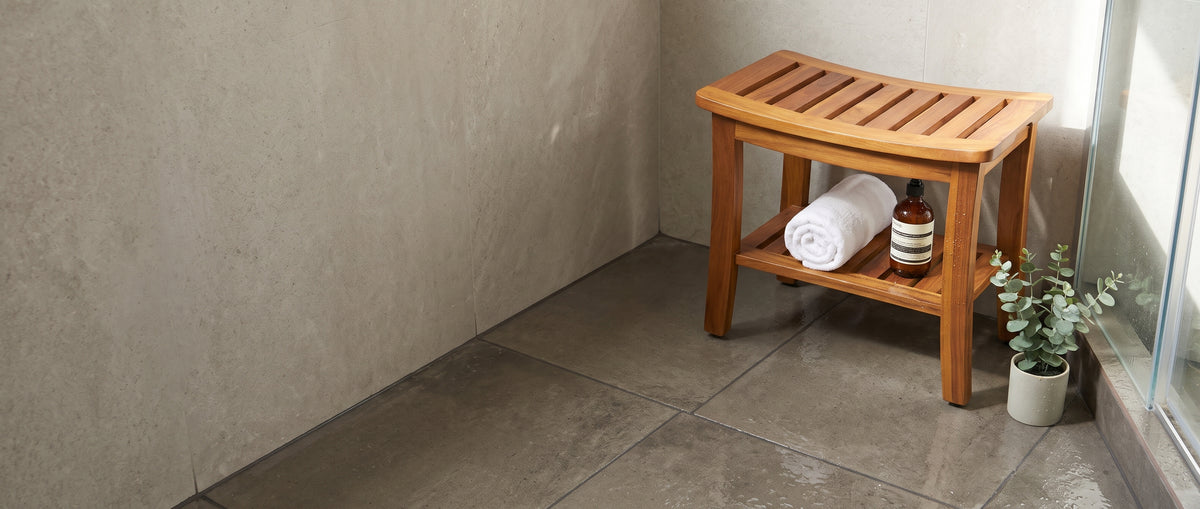
Wood and water usually do not mix. Leave most wooden furniture in a shower and within months it swells, cracks, grows mildew or starts to rot. Teak is the exception people point to, and for good reason: it has been the material of choice for ship decks, harbor furniture and saunas for centuries.
So is teak waterproof? No. No wood is truly waterproof. Teak is something more useful in a bathroom: it is naturally water-resistant and highly resistant to decay, it moves very little as humidity changes, and it is dense and strong enough to support a person on slim slats. Those qualities let a well-built teak bench, shelf or mat handle daily water when it is allowed to dry between uses.
This guide explains the difference between waterproof and water-resistant, the specific properties that make teak suited to wet rooms, how it compares with other woods, its honest limits, and where teak works best in a bathroom.
Is teak waterproof? The short answer
- Teak is not waterproof. Like all wood, it can absorb some moisture, and it should be allowed to dry between showers.
- Teak is water-resistant. Its natural oils and dense grain help water bead on the surface and run off rather than soaking in.
- Teak is decay-resistant. Teak heartwood is rated in the highest natural durability class by timber authorities, which is why it holds up in wet conditions that ruin other woods.
- Teak is dimensionally stable. It swells and shrinks less than many hardwoods as moisture changes, so joints stay tighter and cracks are less likely.
- The best results come from design plus habits: slatted surfaces that drain, raised feet, a quick rinse and good bathroom ventilation.
If you see a wooden shower bench marketed as "waterproof," read the details carefully. A more accurate description is "water-resistant" or "made for wet environments."
Waterproof vs water-resistant: why the difference matters
A waterproof material blocks water entirely. Glass, glazed tile, many plastics and metals are effectively waterproof: water sits on the surface and never enters the material.
A water-resistant material slows water down. It sheds most of the water that lands on it and absorbs only a little, and it tolerates getting wet as long as it can dry out again. Teak belongs in this group.
Why does this matter for a shower bench? Because how you use and care for the bench depends on it. A waterproof plastic stool can sit in a puddle indefinitely (though it will still collect soap scum). A water-resistant teak bench performs best when water can drain off and air can reach it. That is why quality teak benches use slatted seats and shelves, sit on raised feet and work best in a ventilated bathroom.
It also matters for mildew. Waterproof surfaces still grow mildew on soap film; just look at the grout lines in most showers. The US Environmental Protection Agency's guidance is that controlling moisture is the key to controlling mold. A teak bench that dries quickly is easier to keep clean than many waterproof surfaces that stay wet.
What makes teak so well suited to wet rooms
Teak (Tectona grandis) is a tropical hardwood native to South and Southeast Asia and widely grown on plantations, including in Indonesia. Five properties explain its performance around water.
1. Natural oils and extractives
Teak heartwood contains natural oils and other extractives. You can feel them: freshly cut teak has a slightly waxy, oily texture that many other woods lack. These compounds make the surface less absorbent, so water tends to bead and run off. They also make the wood hard for decay fungi and insects to break down.
2. High natural durability
Timber authorities classify woods by how long they resist decay. The Business Queensland timber guide rates teak's above-ground durability as Class 1, its highest class, with a life expectancy of more than 40 years for above-ground timber outdoors. It also lists teak as resistant to termites. Those ratings describe the species in outdoor use, not a particular bench, but they show why teak is trusted where other woods fail.
Independent laboratory testing supports this. A study by researchers at the Swedish University of Agricultural Sciences tested plantation-grown teak against four decay fungi using a European standard method. The outer heartwood performed as very durable, the top class.
3. Low movement with humidity
All wood swells as it takes on moisture and shrinks as it dries. In a bathroom that cycles from steamy to dry every day, that movement is what loosens joints and splits boards in ordinary furniture. Teak moves comparatively little. Business Queensland lists its shrinkage to 12% moisture content at about 2.2% tangential and 1.2% radial, which is low for a hardwood. In practice, that means a teak bench keeps its shape and its joints stay tight through daily humidity swings.
4. Density and strength
At roughly 670 kilograms per cubic meter at 12% moisture content, teak is a dense, firm hardwood. That density lets a bench use slatted seats with gaps for drainage while still supporting adult weight. Most TeakCraft shower benches are rated to 350 pounds, and the heavy-duty Elera and Danica models to 400 pounds.
5. Comfortable, non-slick surface
Teak's grain and natural oils give it a pleasant, slightly textured feel under wet skin. It feels warmer than plastic, metal or stone, which is one reason saunas and spas use wood benches.
Heartwood matters: not all "teak" performs the same
The properties above belong to teak heartwood, the dense inner wood. Teak sapwood, the pale outer band just under the bark, is much less durable. In the same SLU study, sapwood rated only moderately durable.
There is also a wide gap between solid teak and products that only look like teak. "Teak finish," "teak color" and "teak oil finish" often describe a different wood that has been stained or oiled to resemble teak. Those products do not have teak's natural oils inside the wood, and they behave very differently in a wet shower.
When you shop, look for clear wording such as "100% solid teak." Every TeakCraft bench is made from solid Indonesian teak, and models such as the 30-inch Freya shower bench are described as SVLK-certified legal teak. Our guide to solid teak vs teak-finished wood explains how to tell the difference.
How teak compares with other woods for bathrooms
Teak is not the only wood used in bathrooms, but it combines more of the right traits than most. Here is how common alternatives compare for a piece that gets wet every day.
| Material | Natural water and decay resistance | Movement with humidity | Typical bathroom use | Main caution |
|---|---|---|---|---|
| Teak (solid heartwood) | Very high | Low | Shower benches, mats, shelves, caddies | Higher price; needs drying time |
| Bamboo | Depends on adhesive and finish | Varies | Budget stools, caddies, mats | Laminated strips; water can work into seams when the finish wears |
| Acacia | Moderate | Moderate | Accessories, some benches | Usually relies on a sealed finish |
| Western red cedar | Good decay resistance | Low | Saunas, outdoor showers | Soft; dents and scratches easily |
| Eucalyptus | Moderate, varies by species | Moderate | Budget outdoor furniture | Needs regular sealing to last in wet use |
| White oak | Moderate | Moderate | Vanities, trim | Can stain dark with water and metal; needs a finish |
| Pine and other softwoods | Low unless treated | Moderate to high | Rarely suitable in showers | Absorbs water; prone to decay |
The table generalizes across many products and species, and finishes change how any wood performs. For a deeper look at the most common budget alternative, see teak vs bamboo: which holds up better in a wet shower. If you are also weighing plastic or aluminum, our teak vs plastic vs aluminum comparison covers those.
Why does teak tend to come out ahead? Most woods need a sealed finish to survive constant wetting, and when that finish wears through, they become vulnerable. Teak's resistance is inside the wood, so it does not depend on a coating staying intact. That is also why teak benches do not need varnish or polyurethane, which can trap water if it cracks.
The honest limits of teak in a bathroom
Teak is excellent in wet rooms, but it is not magic. Knowing its limits helps you get the most from it.
It can grow mildew on residue. Teak resists mold well, but mildew can grow on soap film left on any surface in a humid room. Rinsing after use and running the fan prevents most spots.
It changes color. Natural teak slowly softens from honey-gold toward silver-gray with water and light. Research on wood weathering, including work co-authored by USDA Forest Service scientists, explains that light breaks down lignin at the surface and water washes it away, leaving a gray layer. It is a surface change, and the wood underneath is unaffected. Oil slows it; sanding and oiling reverses it on natural teak.
It needs to dry. Constant standing water, such as a bench sitting in a low spot where water pools, is hard on any wood.
Harsh cleaners can harm it. Bleach, ammonia, abrasive pads and pressure washers can strip oils and roughen the surface.
It costs more. Solid teak is a premium hardwood. Many owners consider that worthwhile because one good bench can replace years of cheaper ones, but it is a real consideration.
The fix for most of these is a simple routine: rinse, dry, wash every few weeks, and oil occasionally if you want to keep the color. Our guide to caring for a teak shower bench has the full steps.
Design features that help teak handle water
The wood is half of the story. Design does the rest. When you compare teak pieces for a bathroom, look for:
- Slatted surfaces. Gaps between slats let water drain through and air circulate, so the piece dries quickly.
- Raised feet. Rubber or non-slip feet lift the legs out of standing water and grip wet tile. Adjustable leveling feet also handle sloped shower floors.
- Rounded edges. Eased edges are kinder to skin and shed water more easily than sharp corners.
- Solid joinery and stainless hardware. Well-fitted joints and corrosion-resistant fasteners hold up through daily humidity.
- No film finish. Unfinished or oil-finished teak breathes. A thick varnish can crack and trap water underneath.
If you are comparing specific benches, our guide to the best wood for a shower bench and what to look for when buying turns these into a checklist.
Where teak works best in a bathroom
Because of its water resistance, teak is a natural fit for the wettest spots in a bathroom.
- In the shower: a teak shower bench for sitting, shaving or setting down bottles. Slatted designs from 21 to 30 inches wide fit most showers.
- In a shower corner: a corner bench or a three-tier teak bathroom shelf such as the Om corner shower shelf, which is 14 by 14 inches at the base and 39.5 inches tall.
- Outside the shower: a teak bathroom mat gives you a firm, quick-drying place to step out, and it does not stay soggy like a fabric mat.
- Near the tub or vanity: a bench for towels, a stool for reaching high shelves, or a spot to sit while you dry off.
- Outdoor showers and pool areas: teak's long record outdoors makes it a strong choice where sun and rain add to the challenge.
What happens to ordinary wood in a shower
To understand why teak stands out, it helps to picture what a shower does to most woods.
- The surface absorbs water. Less dense woods and woods without natural oils soak up water at the surface and especially through end grain, such as the bottoms of legs.
- The wood swells. As the fibers take on moisture, the boards expand, mostly across the grain.
- It dries and shrinks. When the bathroom dries out, the boards contract again.
- Joints loosen. Repeated swelling and shrinking works joints apart and can crack glue lines.
- Mildew grows on the surface. Soap film plus moisture gives mildew a place to grow.
- Decay can set in. If wood stays wet for long periods, decay fungi can break down the wood fibers, leaving it soft and weak.
Teak interrupts this chain at several points. Its oils slow absorption, its low shrinkage limits movement, and its heartwood resists decay fungi. It does not stop the chain entirely, which is why drainage, drying and a rinse still matter.
Bathroom humidity and how teak responds
A bathroom can swing from very humid during a hot shower to fairly dry an hour later. The US EPA recommends keeping indoor relative humidity below 60%, ideally between 30% and 50%, to limit mold growth.
Teak copes with these daily swings better than most woods because it moves relatively little as its moisture content changes. That said, a bathroom that stays humid all day, with no window or working fan, is hard on any material. Signs your bathroom stays too damp include:
- Mirrors that stay fogged long after a shower
- Peeling paint or bubbling caulk
- Mildew in grout lines or on the ceiling
- Towels that never fully dry
- A musty smell
If you notice these, improving ventilation will help your teak and the rest of your bathroom. Run a properly vented exhaust fan during and after showers, and leave the shower door or curtain open so surfaces can dry.
Teak in each wet zone of the bathroom
Not every spot in a bathroom is equally wet. Here is how teak performs in each zone and what to watch for.
| Zone | How wet it gets | Teak piece | What to watch |
|---|---|---|---|
| Direct shower spray | Soaked every use | Shower bench seat | Rinse soap off; let it dry; place out of the spray if possible |
| Shower corners | Splashed, humid | Corner bench, corner shelf | Lift bottles weekly; keep air gaps at the walls |
| Shower floor | Standing water near the drain | Bench feet, shelf feet | Raised rubber feet; avoid low spots where water pools |
| Just outside the shower | Drips and steam | Bath mat, bench | Stand the mat on edge to dry |
| Tub ledge | Splashes | Caddy, small stool | Empty and dry the caddy |
| Vanity area | Occasional splashes | Stool, small bench | Wipe spills; minimal care |
A simple water-bead test
Curious how your own teak is performing? Try this quick check.
- Make sure the bench is clean and dry.
- Sprinkle a few drops of water on the seat.
- Watch for a minute.
If the drops bead up and sit on the surface, the surface still has plenty of natural or applied oil. If they soak in quickly and darken the wood, the surface has dried out. On natural teak, that is a good time for a thin coat of teak oil after cleaning. This is a rough guide only, because soap film and previous treatments affect how water behaves.
Reading product claims: a quick glossary
Shopping for wet-area furniture means decoding marketing terms. Here is what the common ones usually mean.
| Term | What it usually means | What to check |
|---|---|---|
| Waterproof | Does not absorb water at all | True of plastic and metal; not true of any wood |
| Water-resistant | Sheds most water, tolerates getting wet | Still needs to dry between uses |
| Moisture-resistant | Tolerates humidity better than average | May not handle direct spray |
| Mold-resistant | Less hospitable to mold | Mildew can still grow on soap residue |
| Rot-resistant / decay-resistant | Resists decay fungi | Depends on heartwood content and drainage |
| Marine-grade | Used or rated for boats | Ask what standard, if any, applies |
| Sealed | Coated with a finish | Finishes wear; ask how to maintain them |
If a wooden bench is described as waterproof or mold-proof, treat that as overclaiming. A trustworthy listing will describe teak as water-resistant and give care instructions.
Why teak is chosen for boats, saunas and spas
Teak's reputation in wet places is long-standing. It has been used for ship decks and fittings for generations, and today it remains common on yacht decks, in spa and sauna fittings, and in high-end outdoor furniture. In all these uses, the same properties do the work: natural oils that shed water, high decay resistance, low movement and a surface that stays comfortable and grippy underfoot.
A shower bench asks for exactly the same things on a smaller scale. That is why, among woods, teak is so often the first choice for the shower.
Frequently asked questions
Is a teak shower bench waterproof?
No. A teak shower bench is water-resistant, not waterproof. Teak sheds water and resists decay, which is why it works well in showers, but it should be allowed to dry between uses.
Is there such a thing as a waterproof shower bench?
Benches made entirely from plastic, or from metal with plastic seats, are effectively waterproof because the material does not absorb water. They still collect soap scum and mildew, and many people find them less stable and less attractive than teak.
Does teak need to be sealed for a bathroom?
No sealer or varnish is needed. Teak's resistance comes from the wood itself. TeakCraft recommends an optional thin coat of teak oil every two to three months to keep the color rich and help water bead.
Can teak get wet every day?
Yes. That is what it is chosen for. Rinse off soap and let it dry between showers.
Is teak better than cedar for a shower?
Both resist decay, and cedar is popular for saunas. Cedar is much softer, though, so it dents and scratches more easily in daily use. Teak's higher density and strength make it better suited to a bench people sit on every day.
Why do boats use teak?
For the same reasons bathrooms do: it resists water and decay, stays stable as moisture changes, and provides a grippy surface when wet.
Will teak warp in a steamy bathroom?
Teak's low shrinkage makes warping much less likely than with most woods. Good ventilation and a design that lets air reach all sides help further.
The bottom line
Teak is not waterproof, and anyone selling a "waterproof" wooden bench is overpromising. What teak offers is better suited to real bathrooms: natural water resistance, high decay resistance, low movement and the strength to carry adult weight on slatted, quick-drying designs. Give it a rinse and a chance to dry, and it will reward you with years of use and a look no plastic seat can match.
Explore TeakCraft's solid teak shower benches, handmade from solid Indonesian teak, labeled for indoor and outdoor use, and shipped fully assembled.
Share:
How to Remove Soap Scum and Hard-Water Stains From Teak
How to Create a Spa-Like Bathroom With a Teak Shower Bench